

Hub
Publish a names-only secret inventory to the vault dashboard — values never leave your machine.
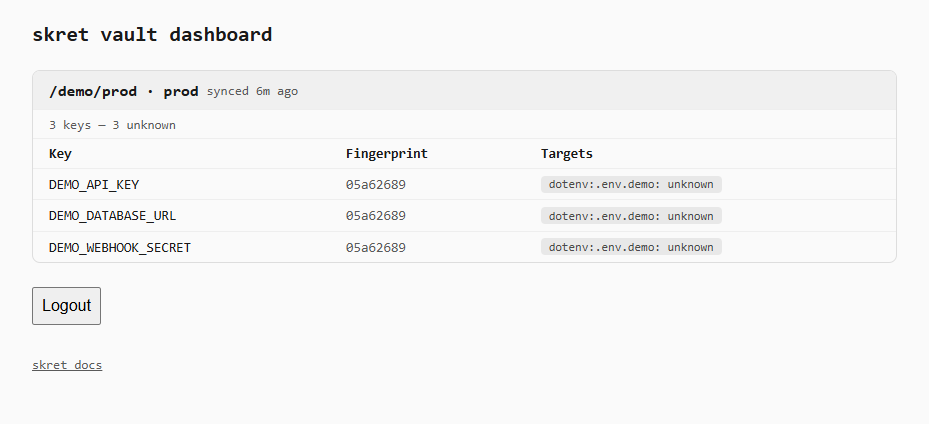
skret hub pushskret hub push sends a manifest: key names, a salted fingerprint per key, and a presence status per sync target. It never sends a secret value.
Setting the hub URL
Section titled “Setting the hub URL”skret hub push --hub-url https://vault.example.comOr declare it once in .skret.yaml so a bare skret hub push picks it up:
sync: hub: url: https://vault.example.com--hub-url overrides sync.hub.url when both are set. If neither is set, skret hub push fails fast with a config error instead of guessing an endpoint.
Authentication
Section titled “Authentication”Set SKRET_HUB_TOKEN to have skret hub push send it as a bearer token:
export SKRET_HUB_TOKEN=hub_xxxskret hub pushWithout SKRET_HUB_TOKEN, the request is sent with no Authorization header.
What’s in the manifest
Section titled “What’s in the manifest”For each secret in the resolved environment, the manifest carries:
name— the secret’s key name (the final path segment, e.g.DATABASE_URLfrom SSM path/myapp/prod/DATABASE_URL).fingerprint— an eight-charactersha256[:8]of the value, salted with a 16-byte deployment salt kept at~/.skret/hub-salt(created on first use,0600, never transmitted). The salt keeps fingerprints opaque to cross-deployment rainbow tables while staying stable across pushes from the same machine.updated_at— the value’s last-modified timestamp from the provider.targets— a map of"<type>:<id>"(e.g."github:myorg/myapp","cloudflare:worker/my-worker") to a presence status (present/absent/unknown), one per target declared insync.targets.
No secret value is ever included, at any point in the request.
Presence status per target
Section titled “Presence status per target”skret hub push looks up presence live, by calling each declared sync.targets entry’s own “list existing secret names” API once per push — the same mechanism skret sync --no-overwrite uses. It does not read the local sync-state cache (~/.skret/sync-state/) at all, so the manifest reflects what is actually at the target right now, not what the last successful skret sync on this machine happened to write.
Each key gets one status per declared target:
| Status | Meaning |
|---|---|
present | The target was asked “what secret names do you have?” and this key’s name was in the answer. |
absent | The target answered, and this key’s name was not in the answer. |
unknown | Presence could not be determined for this target: either its type cannot enumerate existing names at all (a dotenv target — silently), or the lookup call itself failed (network/API error, a required credential like GITHUB_TOKEN not set, or a Cloudflare Pages target, which cannot enumerate and reports it as a failed lookup). A failed lookup never fails the whole push — it prints a warning: line to stderr and marks every key unknown for that one target only. |
A github target and a Cloudflare Worker target (sync.targets: - type: cloudflare, worker: ...) can both enumerate, so they get real present/absent status. A dotenv target always shows unknown, silently — there is no file-independent API to ask. A Cloudflare Pages target also always shows unknown, and additionally prints the warning: line on every push: it cannot enumerate its env vars either, but hub push learns that from a failed lookup rather than from the target type, so it reports it like one.
Credentials for a live presence check
Section titled “Credentials for a live presence check”Because presence is looked up live, skret hub push needs the same credentials skret sync needs for any target it should check: GITHUB_TOKEN for a github target, CLOUDFLARE_API_TOKEN (plus an account id) for a cloudflare target.
- The cron sync container already forwards these from the Worker’s own secrets — no extra setup for the scheduled push.
- Running
skret hub pushby hand (a laptop, CI, anywhere outside the cron container) needs you to export the same variables yourself, exactly as forskret sync:
export GITHUB_TOKEN=ghp_xxxexport CLOUDFLARE_API_TOKEN=xxxskret hub pushWithout them, those targets simply show unknown for every key — the push still succeeds, it just can’t tell you more than that.
Options
Section titled “Options”--hub-url
Section titled “--hub-url”Hub base URL, overriding sync.hub.url from .skret.yaml.
skret hub push --hub-url https://vault.example.comSecurity
Section titled “Security”- Secret values never leave your machine — the manifest carries only names, salted fingerprints, and presence status.
SKRET_HUB_TOKENis read from the environment and sent asAuthorization: Bearer <token>; it is never written to.skret.yamlor logged.- The deployment salt at
~/.skret/hub-saltis generated once per machine and stored at0600. Two machines pushing the same secret produce different fingerprints unless they share a salt.